You’ve spotted something. Argh! Maybe it was a flash of movement behind the fridge. Maybe it was something less pleasant – a small dark deposit on the kitchen bench that definitely wasn’t there yesterday. Either way, you’ve got a visitor, and with alarming hantavirus in the headlines at present, a question that may be leaping to your mind is: what is the difference between rat and mouse infestations, and does it change what I need to do about it?
The short answer is yes – and quite a bit, actually. And that’s despite the fact that both rodents share the same general game plan:
- Find food
- Stay warm
- Breed prolifically
- Avoid you!
Even so, the difference between rat and mouse problems at your place plays out in ways that affect how much damage you’re dealing with, how hard they are to get rid of, and how urgently you need to act.
Here’s what decades of pest control experience has taught our expert pest control tradies – condensed into the things that actually matter.
But first … How to tell which one you’re dealing with
Before anything else, you need to correctly identify your houseguest. The difference between a mouse and a rat isn’t always obvious, especially if you’ve only caught a glimpse – and misidentifying them leads to mismatched traps, wrong bait placement, and a problem that doesn’t go away.
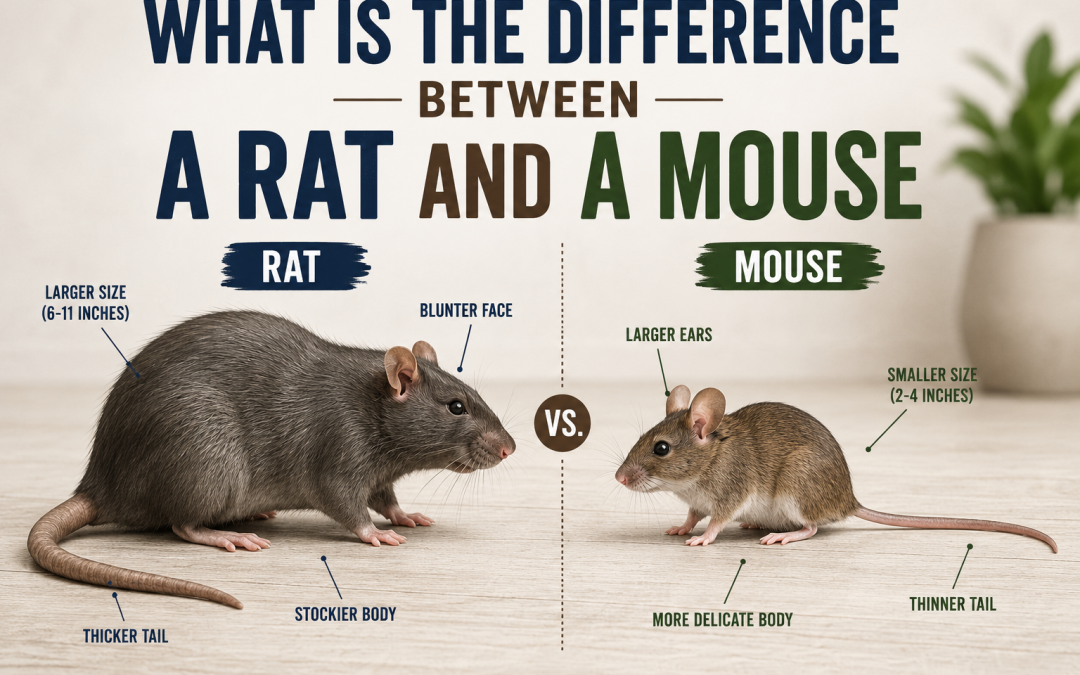
Size is the most obvious starting point, but it trips people up more than you’d think – specifically when it comes to the difference between baby rat and mouse incursions.
A juvenile rat and an adult mouse can look remarkably similar in size and colour. The key is the proportions: baby rats have noticeably larger feet and heads relative to their body size, as though they haven’t quite grown into themselves yet.
An adult mouse, by contrast, is compact and uniform – everything fits. So if the thing you saw had oversized paws and a blocky head, you’re probably looking at a rat that’s still growing. And that matters, because where there’s a young rat, there are almost certainly more.
The ways they differ that actually matter
7 differences – all of them useful, some of them surprising, and one of them that’ll make you act a lot faster than you planned to:
1. Size – And what it means for damage
The difference between a rat and a mouse goes well beyond appearance.
Rats are significantly larger – the common brown rat can reach 40cm including the tail and weigh up to 500 grams!
That extra mass means more gnawing power. Rats will chew through things a mouse simply can’t: hard plastic, soft aluminium, even thin concrete. If you’re finding damage to pipes, wall cavities, or structural timbers, you’re almost certainly dealing with rats.
Mice tend to stick to softer targets – food packaging, insulation, cardboard.
2. Droppings – Your best identification tool
The difference between mouse and rat poop is one of the most reliable ways to confirm which species you’re hosting.
Rat droppings are large:
- Roughly 15-20mm
- Blunt-ended
- Usually scattered along defined travel paths.
Mouse droppings are small:
- Pointed at both ends
- About 3-6mm
- Distributed more randomly and in much higher volume.
Also be aware – mice produce up to 80 droppings per day. If you’re finding what looks like scattered sesame seeds in your pantry, that’s a mouse. But if it’s more like dark grains of rice, that’s a rat.
Both are unpleasant. Neither should be ignored.
3. Behaviour & boldness
The difference between mouse and rat behaviour is significant and affects how you approach removal.
Rats are cautious – neophobic, in pest control terms, meaning they’re suspicious of new objects in their environment. A new trap placed in a rat’s run may be avoided for days before the rat investigates.
Mice are the opposite – curious to a fault. They’ll investigate new objects quickly, which is why mouse traps often produce results faster. Rats are also creatures of habit and follow the same routes repeatedly, which actually works in your favour once you identify their runs.
4. Where they live
Rats prefer to burrow – you’ll find their entry points:
- At ground level
- Along fence lines
- Under concrete slabs
- In subfloor spaces.
They’re strong swimmers and will enter through drains, too, as our plumbing tradies will attest to.
Mice are climbers and tend to nest:
- In wall cavities
- Roof spaces
- Inside insulation.
Knowing where each species likes to operate tells you where to look for entry points and where to place control measures.
5. Health risks
Both species carry disease – but the rat vs mouse risk profile differs in severity.
Rats are associated with:
- Leptospirosis
- Salmonella
- And historically, the conditions that allowed bubonic plague to spread.
Mice, on the other hand, carry:
- Hantavirus
- Salmonella
- Lymphocytic choriomeningitis.
Neither rodent is something you want near your food, your bench surfaces, or your children – of course. The key point: both require prompt action, but rat infestations – given their size, burrowing, and the volume of contamination they can cause – typically carry higher immediate risk.
6. How fast they breed
This one matters more than most people realise. Because the difference between a rat and a mouse in terms of reproduction is a question of scale.
A female mouse can produce up to 10 litters per year with 5-6 pups each – so a small mouse problem becomes a large one with frightening speed.
Rats breed slightly less prolifically but produce larger litters and their young reach reproductive maturity within weeks. The bottom line: whatever you’ve got, the window to act before a manageable problem becomes an infestation is shorter than you think.
7. How you get rid of them
Any great pest control tradie will tell you what works – to both rats and mice:
- Traps
- Baits
- Exclusion.
But the approach differs quite a bit. Why? Because rat-sized traps won’t catch mice and mouse traps won’t hold rats. And bait stations need to be sized and positioned differently. And because rats are bait-shy, the placement and timing of control measures requires more patience.
For either species, professional pest control typically resolves the problem faster and more completely than DIY, particularly when it comes to getting rid of mice and rats properly by identifying and sealing entry points, which is the step most homeowners skip.
Spotted something that made you squeal?
Whether it’s a rat or a mouse, the answer to ‘how urgent is this?’ is always the same: even more urgent than it feels right now.
Tradie Near Me connects you with licensed, insured pest control professionals across Australia – Sydney, Melbourne, Brisbane, Perth, Adelaide, and the Gold Coast. Get an obligation-free quote today and let someone with the right tools handle it properly.