
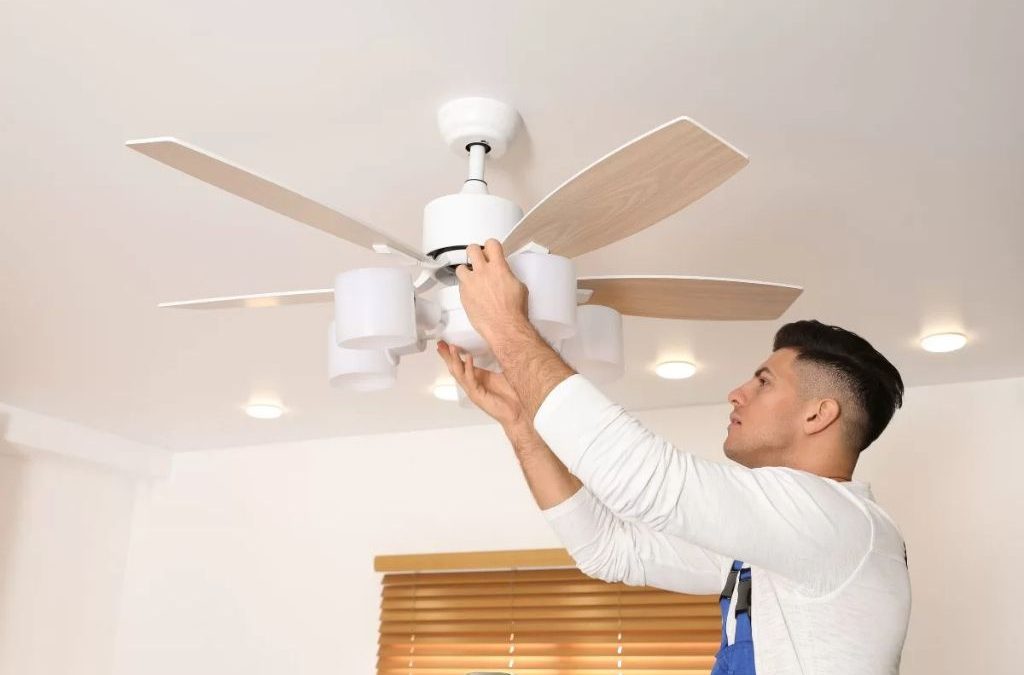
Ceiling fans have a funny way of looking cheap and simple right up until the moment you dive a little deeper into the total ceiling fan installation cost.
All too often, you can see a fan online for a reasonable price, picture it spinning away in the bedroom or over the dining table – and then the practical part of your brain kicks in:
- Does the ceiling already have wiring there?
- Is the mount strong enough?
- What if you want a remote, a wall switch, or a light as well?
It’s usually exactly the moment people start deepening their search: How much to install ceiling fan technology with absolutely everything factored in?
Unfortunately, there’s no one neat answer – but in today’s guide, we’re going to try our best.
The real ceiling fan installation cost depends on:
- The fan you choose
- The room or space it is going into
- How much electrical work needs to happen before the electrician can even hang it?
Not all ceiling fans are the same
We all know there are quite a few different types, but many homeowners fail to factor it into their initial plans. Because from the installer’s point of view, one ceiling fan project is very different to the next.
In Australia, the market is now packed with:
AC fans: Traditional and widely used, these are usually the simplest to install because most electricians are familiar with their standard wiring setups.
DC fans: Quieter and more energy-efficient, but installation can be slightly more involved due to control modules and different wiring requirements.
Fan-and-light combinations: Great for saving space and adding functionality, though installation takes longer as both lighting and fan wiring need to be properly configured.
Smart fans: Offer app or voice control for convenience, but require extra setup and sometimes additional components during installation.
Outdoor-rated models: Built to handle moisture and harsh conditions, which means installation needs weatherproof fittings and careful placement.
Larger-format fans for big open rooms: Designed to move more air across larger spaces, but installation can be more complex due to size, weight, and mounting requirements.
What actually changes the installation cost?
Once you get past the type of fan itself, the rest of the ceiling fan installation cost really comes down to a handful of practical, on-site factors.
These are the things electricians are quietly assessing before they ever give you a number – and they’re also what explains why quotes can vary so much from one home to the next.
1. Existing wiring vs starting from scratch
Let’s start with the single biggest influencer of pricing, and also where most people underestimate the work involved.
If you’re replacing an existing fitting, the job is often relatively contained. The electrician can work with what’s already there – removing the old unit, checking the mounting point, and installing the new fan.
But if there’s no existing connection, you’re no longer asking how much to install ceiling fan infrastructure as a simple swap – you’re asking for a brand new installation point.
That can involve:
- Running new cabling through the ceiling
- Installing a proper fan-rated mounting bracket
- Adjusting or adding wall switches
- Working inside roof cavities to get everything into place.
It’s at this point where the new ceiling fan installation cost starts to climb quickly compared to a basic replacement.
2. Mounting support & ceiling structure
It’s important to remember that a ceiling fan isn’t just hung – it needs to be properly supported.
Fans generate constant movement and vibration, which means the mounting point must be fixed to a solid structure. If the existing point isn’t suitable, the electrician may need to reinforce or rebuild it before installation can even begin.
From a pricing perspective, this is one of the most overlooked factors affecting the cost of ceiling fan installation.
It’s also why quotes sometimes change after inspection – what looks fine from below doesn’t always meet requirements once the ceiling space is checked.
3. Access to the ceiling space
Two homes can have the exact same fan and still receive very different quotes purely because of access.
A straightforward job might involve a standard-height ceiling with easy roof cavity access. But once conditions become more difficult, labour time increases.
Things that slow an installation down include:
Tight or restricted roof spaces: Limit movement and slow down cable runs and positioning.
Raked or very high ceilings: Requires extra setup, height access, and more careful mounting.
Insulation that needs to be worked around: Adds time to safely clear space and avoid damage or hazards.
Awkward locations like stairwells or voids: Make access difficult, often needing ladders or specialised setup.
Often, it’s here where the electrician ceiling fan installation cost calculations get really varied – not because of the fan, but because of how hard it is to safely reach and install it.
4. Control setup & wiring complexity
Not all fans are controlled the same way, and this can quietly add complexity to the job.
A basic fan might run off a simple wall switch. But once you start adding features, the setup becomes more involved:
- Separate switching for fan and light
- Remote receivers inside the canopy
- Smart control modules or app integration
- Dimmable lighting or speed controllers.
It’s exactly why the ceiling fan with light installation cost is typically higher. Because you’re no longer installing a single function – you’re configuring multiple systems to work together cleanly.
5. Ceiling height, positioning & hardware
You might imagine that placement matters a lot, but most people don’t realise just how much.
- Low ceilings may require compact “hugger” fans
- High or sloped ceilings often need extension rods to position the fan correctly for airflow and safety.
- Outdoor or exposed areas also introduce additional requirements, such as weather-resistant fittings and more careful placement.
Small adjustments like these feed into the overall ceiling fan and installation cost, because they affect both the parts used and the time required to get everything right.
6. Replacement jobs are usually the cheapest
When everything lines up – existing wiring, solid mounting, easy access – installation can be relatively quick. It’s why the average cost ceiling fan installation number you’ll see quoted online usually reflects straightforward replacement jobs rather than full new installs.
In these cases, the work is mostly about:
- Removing the old fitting
- Installing the new fan
- Testing and balancing the unit.
Sounds simple enough, but once any of the earlier factors come into play, the job moves beyond that average price range.
Real-world pricing: What to expect
As a rough guide in Australia, most installations fall into three broad ranges:
Simple replacement: Around $150-$300
Moderate install (added complexity): Around $300-$600
More complex jobs: $600 plus, depending on access, wiring and setup.
People searching for a simple or ballpark ceiling fan installation price often get frustrated – and we get that. But it’s not that quoted numbers out there are wrong, they’re just based on very different scenarios.
Once you understand:
- Whether you’re replacing or starting fresh
- How complex your fan setup is
- And how accessible your ceiling space is…
… then the pricing starts to make a lot more sense.
Need a clearer quote for your home?
If you are trying to compare numbers online, that will only get you so far. The only way to know your real ceiling fan installation cost is to have a licensed electrician look at the room, the ceiling and the fan you actually want installed – and more details on top of that as well.
Tradie Near Me helps connect homeowners with real, licensed and insured tradies in your exact area, so you can get a proper quote without wasting time ringing around. If you want clear pricing, practical advice and someone who can tell you whether your chosen fan is actually right for the job, get your quote today.
Related posts:
 Ceiling Fan Installation Costs in Australia
 Rangehood Installation Cost Guide
 6 Factors To Understand Your Downlight Installation Cost
 Ceiling Fan Troubleshooting? Answer These 6 Questions
 4 Critical Differences Between Indoor & Outdoor Ceiling Fans
 AC vs DC Ceiling Fans – All The Pros & All The Cons