
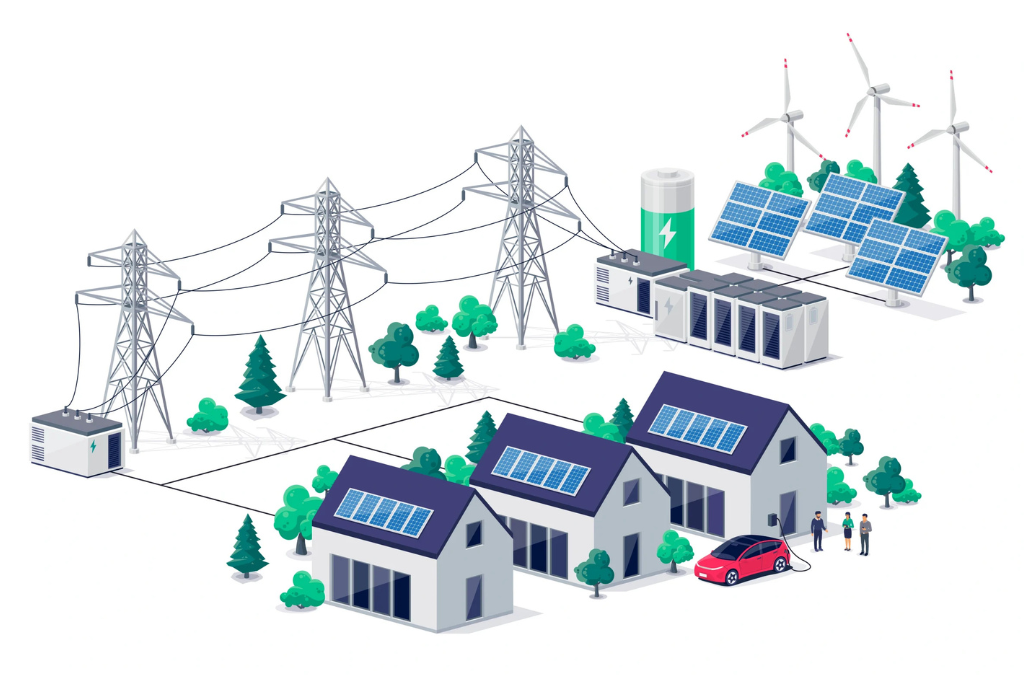
Solar and battery owners all across Australia are increasingly being asked the same question by their energy retailer: do you want to join a virtual power plant? Before answering yes or no, it’s worth understanding exactly what you’d be agreeing to. And before we even get to that part of our blog, we’ll need answer: What is a virtual power plant, exactly?
What is a virtual power plant?
Before we get any deeper, we’d better just answer this one upfront:
A virtual power plant connects individual home solar and battery systems into a coordinated network managed by an energy retailer or third-party operator. It means that when the broader electricity grid is under pressure – say, in a heatwave or a supply shortfall – the operator can draw stored energy from participating batteries across the network to help stabilise supply.
Why would you do that? Well, in exchange, participating households typically receive a financial benefit:
- Bill credits
- A reduced tariff
- A payment for energy contributed.
Sounds pretty good right? But whether it’s actually worth doing depends entirely on your specific setup, your usage, and your goals.
Oh, and your answers to our checklist …
The VPP decision checklist
If you run through these seven questions honestly, you’ll know exactly where you stand before signing anything.
1. Do you have a compatible battery?
This is the non-negotiable one. Because a virtual power plant VPP program requires a home battery – solar panels alone aren’t enough, since there’s nothing for the network to draw on without storage.
Not every battery model is compatible with every VPP program – so you’ll have to check the specific brand and model against the operator’s approved list before going further.
PROCEED IF: You already have a battery, or you’re planning to install one regardless of VPP participation.
STOP HERE IF: You only have solar panels and aren’t planning to add storage.
2. Is your overnight and evening usage manageable?
VPP participation means the operator may draw on stored energy during dispatch events, which reduces what’s available for your own household use at that time.
So, does your evening routine depend heavily on a fully charged battery?
- Running air conditioning?
- Charging an EV?
- Powering through a long evening?
A VPP that reduces your reserve at the wrong moment could leave you short.
PROCEED IF: Your battery typically has surplus capacity beyond what you need for a normal evening.
BE CAUTIOUS IF: You’re already running close to your battery’s limits most nights.
3. Have you compared the VPP benefit against your current feed-in tariff?
Now we’re getting deeper into your financial decision here. Because some VPP programs offer less value than simply exporting excess solar at your current feed-in rate, particularly in states with strong existing tariffs.
Get the specific numbers from the program:
- The credit amount
- The payment per dispatch event
- The reduced tariff rate.
Then, compare it honestly against what you’re earning now.
PROCEED IF: The VPP offer is clearly better than your current export arrangement, in writing.
STOP HERE IF: You can’t get a clear answer on what the program actually pays, or the numbers don’t beat your current setup.
4. Does joining require switching energy retailers?
Many VPP programs are tied to a specific retailer, which means joining could mean leaving your current provider – with everything that involves, including any current contract terms and the hassle of switching.
PROCEED IF: You’re already open to switching retailers, or the VPP is offered by your current one.
BE CAUTIOUS IF: You’re locked into a good deal elsewhere, and switching would cost you more than the VPP gains you.
5. Are you comfortable with reduced control during dispatch events?
Reputable VPP agreements include a reserved minimum battery level for household use, so you’re not left with zero backup power. But during an actual dispatch event, the operator is drawing on energy above that threshold – meaning you have less control over your battery’s behaviour during that window than you would running it independently.
PROCEED IF: You’re comfortable with periodic, time-limited reductions in battery autonomy.
STOP HERE IF: Full manual control over your battery at all times is a priority for you.
6. Have you checked how dispatch events affect your warranty?
VPP participation means more frequent charge and discharge cycles than standalone use. This accelerates wear over time.
Most batteries are warrantied with this kind of cycling in mind, but it’s worth confirming with the manufacturer or installer that VPP participation doesn’t void or affect your warranty terms.
PROCEED IF: Your battery’s warranty explicitly accounts for VPP-style cycling, or the additional wear is negligible for your battery type.
BE CAUTIOUS IF: Your warranty terms are unclear or your battery is already several years into its expected lifespan.
7. Does the community and grid benefit matter to you?
Not every decision is purely financial, is it? Australia’s high rate of rooftop solar – particularly in Queensland – creates genuine challenges for grid stability, and VPPs are one of the more effective tools for addressing that at scale.
If contributing to a more stable, more renewable-reliant grid carries weight for you independent of the direct financial return, that’s a legitimate factor in the decision.
Scoring your VPP checklist
If you answered “proceed” to most or all of the above, a VPP genuinely looks like a sound fit for your household. If you found yourself stopping at questions 2, 3, or 5 in particular, it’s worth either negotiating better terms, waiting until your setup changes (a bigger battery or a different tariff situation), or simply continuing with your existing solar export arrangement.
What is a virtual power plant worth to you specifically is the only version of that question that actually matters – and this checklist is designed to get you to a clear answer rather than a guess.
Find a solar & battery specialist near you
Still not quite sure? If you’re weighing up a VPP and want a professional assessment of your system’s compatibility or battery sizing or you just want to find out more, Tradie Near Me connects you with licensed local solar and battery specialists who can give you a straight answer.
Get an obligation-free quote today.
Related posts:
 How To Safely Run Power To Your Shed: A Homeowner’s Guide
 Essential Builders Clean Checklist For Spotless Handovers
 Power Points Not Working? Try Our 10-Step Troubleshooting Guide
 Roof & Gutter Maintenance Checklist: Preventing Leaks & Extending Roof Lifespan
 How Long Do Solar Batteries Last in Australia?
 How To Get A Lower Than Average QLD Electricity Bill