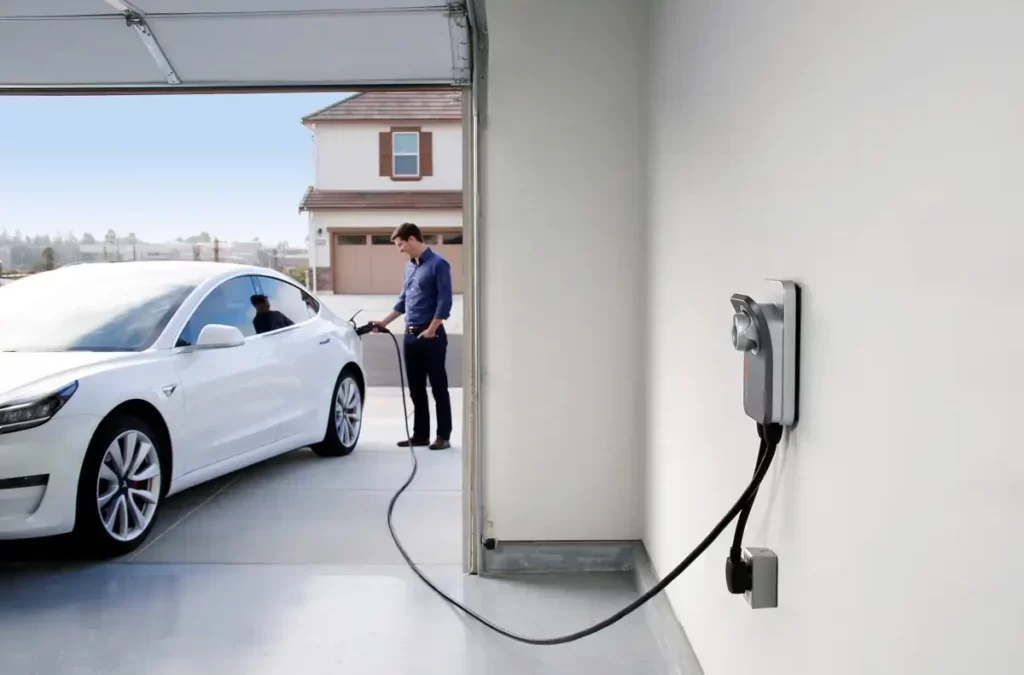
There’s a specific moment most new EV owners describe – somewhere between excitedly signing the paperwork on their shiny electric vehicle and pulling into the driveway for the first time – where the question quietly surfaces: right, so how does this thing actually charge at home? That question leads pretty quickly to a search on EV charger installation cost.
And it’s exactly at that point where a lot of people hit their first wall:
- The numbers they find online are all over the place
- The terminology is unfamiliar
- And what looks like a simple job starts to feel surprisingly complicated.
We’ve put together this cost guide to fix all of that. We’re going to walk through how home EV charging actually works, what the real variables are, and why two houses on the same street can get quotes that are hundreds of dollars apart.
Let’s dive right in:
The EV charging landscape in Australia right now
Electric vehicles are no longer a novelty in Australia. In fact, sales have been climbing extremely sharply, just as more manufacturers are releasing affordable models – and the infrastructure around them is growing fast, too.
But unlike a petrol car – where you simply find a servo – EV ownership works differently. Most drivers do the majority of their charging at home, overnight, using off-peak electricity rates. When done right, at-home EV charging is:
- Cheaper
- A lot more convenient
- And completely routine.
Sounds good, right? What makes EV charger installation a category of its own is the fact that it sits right at the intersection of vehicle technology and residential electrical work. In other words, it’s not a toaster you plug in – it’s a dedicated piece of electrical infrastructure that connects your car to your home’s power supply. And that connection has to be done properly, safely – and by reputable, licensed electrician.
Level 1, Level 2 – What are we actually talking about?
Before getting into the costs, it helps to understand what type of charger most homeowners are actually installing:
Level 1 chargers: They plug into a standard household power point, but they’re slow – adding roughly 3 to 5 km of range per hour. And while they cost almost nothing to set up, they’re really only practical for plug-in hybrids or drivers with very low daily kilometres.
Level 2 chargers: They’re the real answer for most households. Operating on 240V, they deliver 25-40 km of range per hour, meaning a typical EV can be fully charged overnight. Understanding the cost of level 2 EV charger installation is essentially the main event for most homeowners doing this research – and that’s what the bulk of this guide is about.
DC Fast Chargers (Level 3): These exist, too, but they’re industrial-grade units designed for commercial environments. An EV charging station of this type starts at $15,000 or more for the hardware alone and is not a realistic home option.
What does it actually cost?
As a general guide for Australian homeowners in 2025, the total cost – hardware plus installation – typically falls somewhere in the range of $1,200 to $2,600, depending on the setup.
But let’s break that down further:
Simple single-phase replacement or straightforward install: $850-$1,500.
More involved jobs with moderate complexity: $1,500-$2,000.
Complex installs, 3-phase, long cable runs, switchboard upgrades: $2,000-$2,600 plus.
The hardware itself – the physical wall-mounted unit – generally sits between $700 and $2,000, depending on brand and features. The EV home charger installation cost you actually pay is that hardware figure plus whatever the electrical work requires.
When people search for the average cost of EV charger installation, the numbers they find often reflect the simpler end of the market. Real-world pricing climbs quickly once any of the variables below start stacking up.
What actually changes the price
Once you get past the charger itself, the real variables are all about what’s already in your home – and what isn’t:
1. Single-phase vs three-phase power
Most Australian homes run on single-phase power, which supports up to 7kW charging – perfectly adequate for the majority of EV owners.
So:
- If your home already has three-phase power, the 3-phase EV charger installation cost typically runs from $1,800 to $2,600, reflecting both the more capable charger hardware and the additional wiring involved.
- For homes that don’t have three-phase and want it, the cost of upgrading the electrical connection itself can run into the thousands before a single charger component is even purchased.
However, it’s not always necessary – but for those wanting 22kW charging speeds, it’s unavoidable.
2. Your switchboard
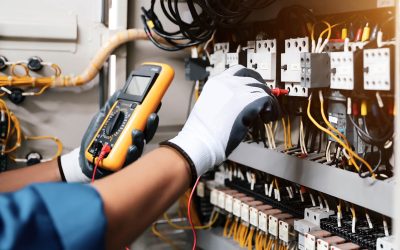
The switchboard is the hub of your home’s electrical system, and it has a big say in the home EV charger installation cost.
Older switchboards – particularly those still running ceramic fuses rather than modern circuit breakers – may not be able to safely accommodate a dedicated EV circuit. In these cases, a switchboard upgrade is required before installation can proceed, typically adding $1,500-$2,500 to the total.
Even newer boards can sometimes be full or lack the spare capacity needed. It’s one of the reasons a proper site inspection matters before any quote can be considered final.
3. Distance from the switchboard
Cable runs are one of the most underestimated cost factors in any EV charger project. A garage located directly adjacent to the switchboard is a very different job from one at the far end of the property – or worse, on the opposite side of a double-brick wall.
The EV wall charger installation cost can change noticeably once cable runs extend beyond 10-15 metres.
Longer distances mean:
- More cable
- More conduit
- More labour
- Sometimes trenching or working through cavity walls.
It’s not always visible from the outside, but electricians price it carefully.
4. Charger type & features
The hardware you choose has a direct bearing on the overall EV car charger installation cost – not just because of the unit price, but because of what that unit requires to function.
- A basic single-phase charger with no smart features is a straightforward installation.
- Step up to a smart charger with Wi-Fi, solar integration, app control, or vehicle-to-home (V2H) bidirectional capability, and the installation becomes a lot more involved.
Smart chargers need to be properly configured, sometimes paired with additional components, and tested against your home energy setup before they’re ready to use.
Popular brands in Australia – including Tesla Wall Connector, Wallbox, Zappi, and BYD – all sit in slightly different price brackets and have different installation requirements. Your electrician will be familiar with most of them, but it’s worth confirming compatibility before you purchase hardware.
5. Wall type & mounting location
Brick walls predictably take longer to work through than plasterboard. External mounting in an exposed location may require weatherproof fittings.
These also all add labour time:
- Stairwells
- High ceilings
- Unusual access paths.
It sounds minor, but in a job where labour is a significant portion of the total, these things add up. The physical mounting location is something a good electrician will assess early – and it’s worth thinking about practically before you call anyone. Where the charger is most convenient to use is not always where it’s cheapest to install.
6. Compliance & Ccrtification
In Australia, EV charger installation must be carried out by a licensed electrician – not a general handyman, not a DIY project. Every installation requires a Certificate of Compliance (or equivalent, depending on your state), which confirms the work meets Australian electrical standards.
Some charger brands also require certified installers to maintain warranty validity. It’s worth checking this when you’re selecting hardware, because using an uncertified installer to save money upfront can void the warranty entirely and create compliance issues down the line.
7. Solar integration: A growing consideration
More and more homeowners are asking whether their EV charger can draw from their solar system rather than the grid – and the answer is yes, with the right setup.
Smart chargers with solar integration can be configured to charge only when excess solar energy is available, which can dramatically reduce running costs over time.
The cost of solar-integrated EV charging varies depending on:
- Your existing solar setup
- The inverter you’re running
- The charger model.
It’s a consideration worth raising with your electrician at the quoting stage rather than retrofitting later.
Getting a quote that actually means something
One of the most frustrating parts of researching EV charging installation costs online is that the numbers are technically accurate – they’re just accurate for jobs that may be nothing like yours.
A straightforward swap in a modern home with a large switchboard and a garage wall next to it sits in a completely different bracket to:
- A period home
- A detached garage
- A property that needs a three-phase upgrade.
The only way to know what your installation will actually cost is to have a licensed electrician look at your specific situation – starting with your switchboard and then looking at cabling, wall type, and what charger you want. Everything else is an estimate.
Tradie Near Me connects homeowners across Australia with licensed, insured electricians who can assess your home and provide a real quote – not a ballpark pulled from a comparison site. If you’re ready to stop guessing and get a clear answer, request your obligation-free quote today.