An invasion of tree roots in pipes and drains at your place is one of those plumbing problems that can be anything from a minor inconvenience to a major structural repair – and the difference between those two outcomes usually comes down to how early it’s caught and how seriously it’s taken.
The frustrating thing is that root intrusion tends to creep in slowly, with you hardly noticing anything at all. And if you do notice something early on, the symptoms can be so slight that it’s easy to dismiss as ‘just one of those things’ or something else entirely.
And before you know it, the problem is significantly worse than it ever needed to be. That’s why we’ve put together this guide – to help you work out where on the severity scale your situation sits, and what the appropriate response looks like at each stage.
Stage 1: Act now, fix cheaply
The early signs of tree roots in pipes at this stage are subtle and easy to ignore.
You might notice:
- Drains that are slightly slower than they used to be
- Occasional gurgling from a drain after you flush the toilet
- A slightly sluggish toilet.
Things like that. In other words, nothing dramatic. Nothing that feels urgent.
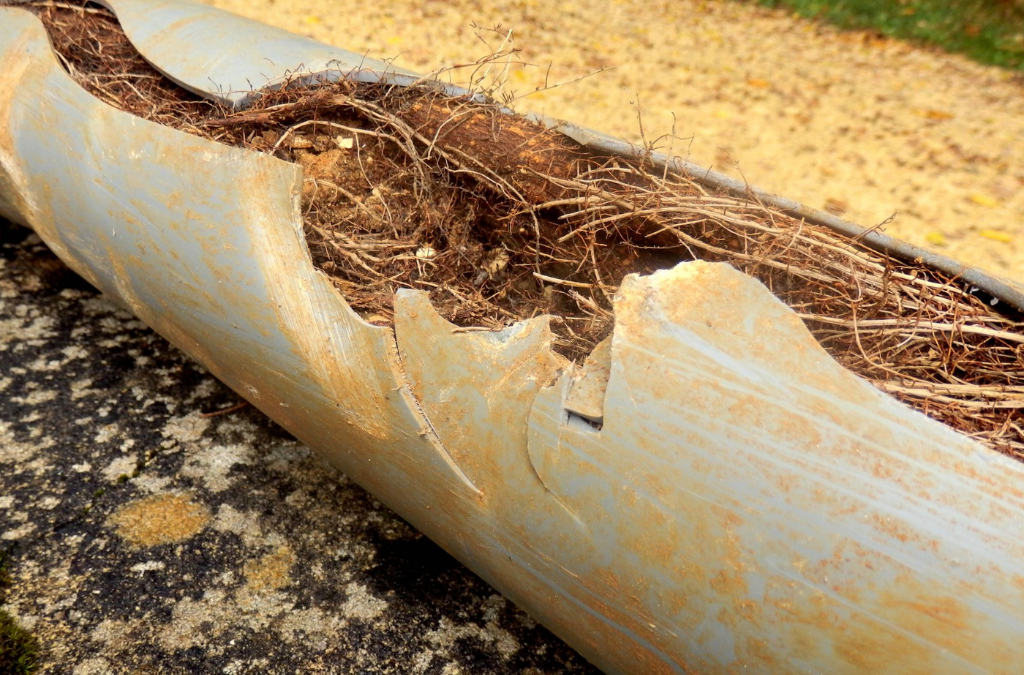
What’s happening at this stage is that fine root tendrils – sometimes called root hair – have found a crack or a joint in the pipe and entered the line. They’re still small, still causing only partial restriction, and the line is still functioning. But roots that have found water and nutrient-rich conditions inside a pipe don’t stop growing.
YOUR RESPONSE AT THIS STAGE:
- A CCTV drain inspection confirms whether roots are present and how far they’ve penetrated.
- Mechanical clearing with an electric eel or hydro-jetting removes the intrusion cleanly.
If caught here, the fix is relatively straightforward and inexpensive. The pipe may still be structurally sound and require no further work beyond clearing.
Stage 2: The problem is establishing itself
If you’ve had a drain cleared once and the same problem has returned within months, you’re probably at Stage 2.
Tree roots in drains at this point have established a more significant presence – the root mass inside the pipe is larger, it’s causing more consistent restriction, and it’s growing back faster after each clearing because the entry point in the pipe is still open and inviting.
How fast do tree roots grow back in sewer pipes after clearing? In warm climates and during active growing seasons, roots can return to a blocking size within 3-6 months of mechanical clearing if the underlying pipe damage isn’t addressed. Clearing without repairing is a maintenance cycle, not a fix.
YOUR RESPONSE AT THIS STAGE:
- CCTV inspection to assess the condition of the pipe at the entry point.
- If the crack or joint failure that allowed root entry is identifiable and not too extensive, pipe relining is often the right solution.
Pipe relining is when a new liner is inserted and cured inside the existing pipe, sealing the entry point permanently without excavation. A licensed plumber can quote on relining versus ongoing maintenance clearing to help you make the right call financially.
Stage 3: Multiple fixtures affected
When tree roots in drainage pipes have moved beyond a single branch line and into a shared sewer or stormwater line, multiple fixtures start showing symptoms simultaneously:
- Toilets that back up when the washing machine drains.
- Showers that gurgle when the kitchen sink is used.
- Two or more areas of the home affected at the same time.
Almost always, these symptoms point to a blockage in a shared line rather than individual fixtures. At this stage, the root mass is typically substantial – a significant restriction or near-complete blockage in a main line.
Hydro-jetting is usually required rather than mechanical clearing alone, and the pipe condition underneath the roots is a serious concern.
YOUR RESPONSE AT THIS STAGE:
- Hydro-jetting to clear the main line
- CCTV inspection to assess structural damage.
Tree roots in plumbing pipes at this level of intrusion often cause things like pipe cracking or joint failure that requires repair beyond simple clearing. Pipe relining for longer sections, or in some cases excavation and replacement of severely damaged pipe, may be necessary.
Stage 4: ‘This is a repair job!’
If a CCTV inspection reveals collapsed pipe sections or cracking, or pipe displacement caused by root intrusion, the situation has moved beyond drain clearing into structural repair. Tree roots in drainage pipes at this stage aren’t just blocking flow – they’ve compromised the integrity of the pipe itself.
It’s also at this stage where you may be wondering: Tree roots in pipes – who is responsible?’
Generally:
- The property owner is responsible for pipes within the property boundary.
- The water authority is responsible for pipes in the public easement or beyond the property boundary.
Where the damage sits determines who bears the cost – and a CCTV report from a licensed plumber provides the documentation needed to make that determination clearly.
YOUR RESPONSE AT THIS STAGE: Licensed plumber assessment is non-negotiable. Options range from no-dig pipe relining for sections with structural compromise but intact pipe walls, through to excavation and full pipe replacement where collapse has occurred. This is not DIY territory under any circumstances.
Can you kill tree roots in pipes yourself?
Knowing how to kill tree roots in pipes without professional help is a reasonable question at Stage 1 or early Stage 2:
- Copper sulphate crystals flushed down the drain kill root material on contact and can slow regrowth – they’re available at hardware stores and are safe for most pipe types in the concentrations used.
- Foaming root killers work similarly and penetrate further into root mass.
But the honest answer on how to kill tree roots in pipes permanently is that chemical treatments slow regrowth but don’t address the entry point. They buy time, not a permanent solution. For anything beyond the earliest stage, a plumber with a CCTV camera and a hydro-jet will achieve what chemicals can’t.
Preventing tree roots in sewer pipes going forward
Preventing tree roots in sewer pipes starts with tree selection and placement – species with aggressive root systems planted close to drain lines are the primary cause of the problem. If you’re landscaping near existing drain lines, choosing trees with non-invasive root systems and planting at appropriate distances from the pipe runs significantly reduces long-term risk.
For existing trees near drain lines, annual CCTV inspection catches early intrusion before it becomes expensive. Pipe relining of vulnerable sections – even before roots have entered – seals joints and cracks proactively and is far cheaper than the repair bill that follows significant root damage.
Not sure where you sit on the scale?
A CCTV drain inspection answers that question definitively – and it’s the starting point for any root intrusion assessment. Tradie Near Me connects Australian homeowners with licensed local plumbers who carry the equipment and experience to assess, clear, and repair root intrusion at every stage. Get an obligation-free quote today.